In my practice, I often hear patients describe their knees as feeling “stuck” or “bone-on-bone.” Usually, they think of the knee as a simple hinge that only moves back and forth. But as a physical therapist, I know the secret to a happy knee actually lies in a movement most people ignore: rotation. Think of your knee less like a door hinge and more like a deadbolt lock. To fully straighten and stay stable, it has to “twist” into place. If you lose that rotation due to injury or just sitting too much, every step you take starts to feel like you’re forcing a lock that won’t turn.
The Move: Seated Tibial Rotations (CKC)
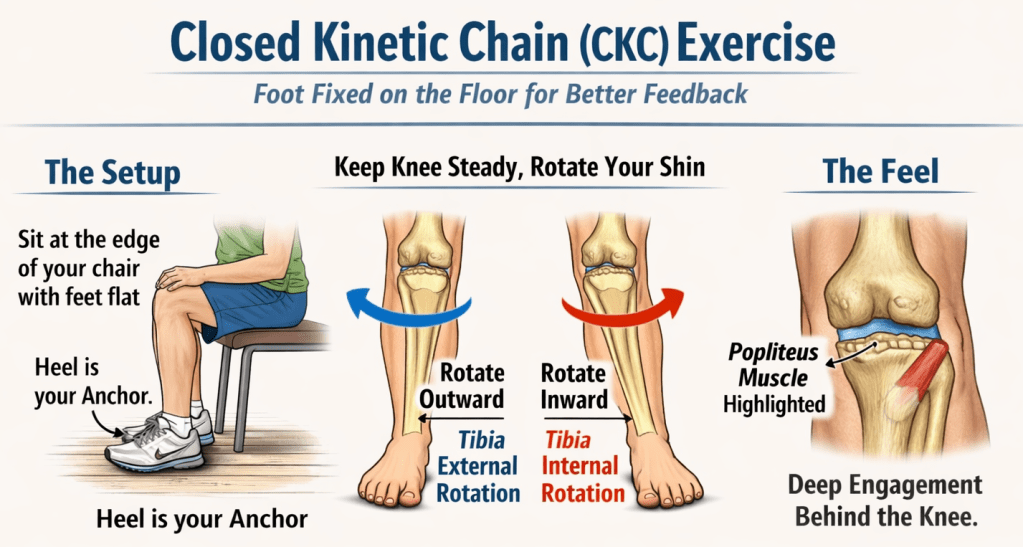
This is a “Closed Kinetic Chain” (CKC) exercise, meaning your foot is fixed against the floor. This gives your brain and joints much better feedback than just kicking your leg in the air.
Setup: Sit at the edge of a chair with both feet flat on the floor. Place a yoga block (or small pillow) between your knees to prevent side-to-side movement. Keep your heel firmly planted — this is your anchor.
Movement: Keeping your knee steady, gently rotate your shin bone (tibia) outward by moving your foot slightly away from midline. Hold this position for 5 seconds. Slowly rotate your shin inward by moving your foot back toward midline. Hold again for 5 seconds.
Key to correct movement: Do not let your knees wobble or collapse inward/outward. The movement should be small and controlled. Focus on feeling subtle engagement deep behind the knee. Perform 10 repetitions (outward + inward = one rep). Move slowly and with control throughout the exercise.
Why This Matters for You
When we work on this rotation, we are facilitating what we call the “Screw-Home” Mechanism. In those last few degrees of straightening your leg, the shin bone must rotate outward to lock the joint into its most stable position.
The Benefits:
- Easier Transitions: It makes standing up from a deep sofa or getting out of the car feel smoother and less painful.
- Better Tracking: It helps your kneecap stay in its proper groove, which is the best way to get rid of that “grinding” sensation (crepitus).
- Joint Longevity: By oiling the rotation, you reduce the sheer stress on your meniscus and ligaments.
A Little Space Goes a Long Way
Our bodies aren’t built to be rigid. We are designed for these subtle, spiraling movements. By spending just two minutes a day on this tibial twist, you’re giving your knees the room they need to breathe and move. Next time you’re at your desk, give your shins a little rotation. You aren’t just stretching; you’re unlocking your potential for better movement.
STAY INFORMED! STAY HEALTHY!
 Physio Insights